
A donut box needs to do more than hold a few pieces of bakery food. It has to protect the donuts during handling, leave enough room for toppings and fillings, remain practical for takeaway or delivery, and still present the brand well when the customer opens it. For bakeries and food brands, these requirements make the structure of a custom donut paper box an important part of packaging development. The right box is not necessarily the most complicated one. It is the structure that fits the product, production process, and sales channel without creating unnecessary cost.
Start With the Product, Not the Box
The size and shape of the donuts should determine the basic dimensions of the packaging. Standard ring donuts, filled donuts, oversized products, and decorated donuts can require different amounts of internal space. The same applies to the number of pieces packed in one box. A box for two donuts may prioritize compactness, while a six- or twelve-piece donut packaging box needs enough room to prevent products from pressing against each other during transportation.
Clearance also matters. If the box is too low, icing, chocolate, cream, or other toppings can touch the lid and affect the appearance of the product. If the box is too large, the donuts may move around when the package is carried or delivered. Measuring the actual product before finalizing the box structure helps avoid both problems and gives the manufacturer a more accurate basis for developing the packaging.
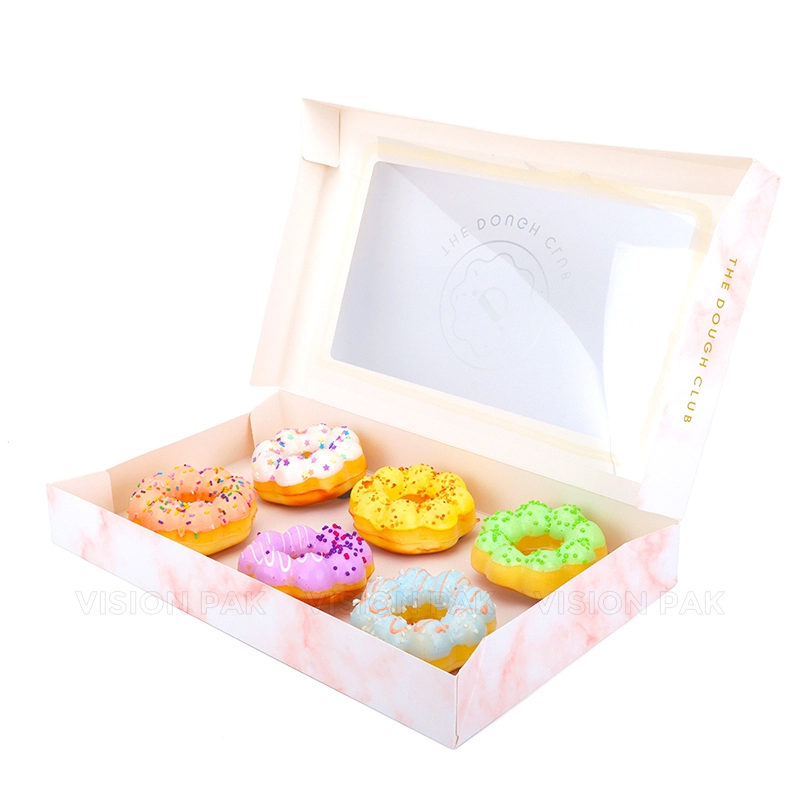
Match the Structure to the Sales Channel 📦
The same donut paper box may not be suitable for every selling environment. A bakery that mainly sells donuts over the counter may focus on quick assembly and easy opening, while a business that relies heavily on delivery needs to pay more attention to box stability and product movement.
Folding cartons are often practical for bakery packaging because they can be stored flat and assembled when needed. Tuck-end structures, locking designs, and other folding constructions can be considered according to the required level of closure and handling convenience. For premium or gift-oriented donut products, a more distinctive structure may make sense, but for everyday high-volume sales, simple and efficient packaging is often more useful.
Protection Should Be Part of the Structure 🛡️
Donuts can be surprisingly difficult to package because their surface is often the most visually important part of the product. Frosting, powdered sugar, chocolate coatings, cream fillings, and decorative toppings can easily be damaged if the box does not provide sufficient clearance.
A well-designed custom donut box should keep the product reasonably stable without making the packaging unnecessarily large. For assorted products, dividers or inserts may also be considered when different donuts need to be separated. The purpose is not to add packaging components simply for appearance, but to solve a specific protection problem.
For delivery orders, this becomes even more important. The box may be picked up, moved between vehicles, stacked with other packages, or handled several times before reaching the customer. A structure that works perfectly on a bakery counter may not provide the same performance during transportation.
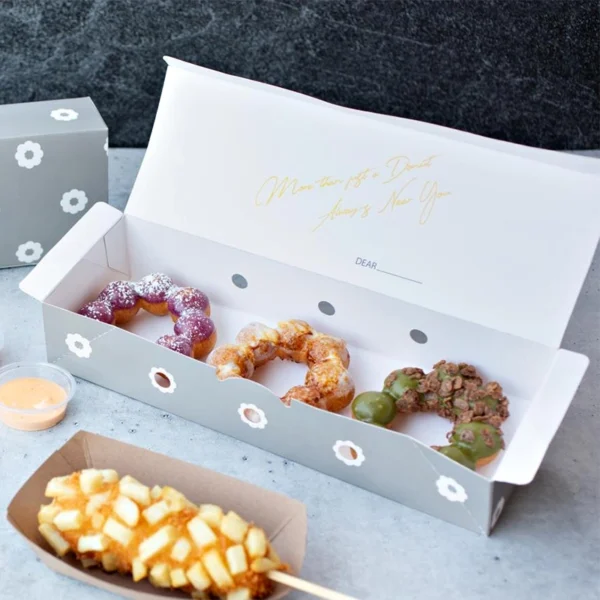
Consider Paper, Printing, and Box Structure Together 🎨
Paper selection should be discussed alongside the structure rather than treated as a separate decision. The paper needs enough stiffness to support the finished box while also providing a suitable surface for printing and finishing. Depending on the brand and application, different paper options can create different results in terms of rigidity, appearance, print quality, and cost.
The same applies to printing. A custom printed donut box may use a simple logo and brand color, or a more detailed design with patterns and illustrations. However, artwork should always be developed with the actual box structure in mind. Folding lines, openings, edges, and assembled panels can all affect how the final design appears.
For a bakery brand, packaging does not need to be visually complicated to be effective. A well-proportioned box with consistent branding can often create a stronger impression than a heavily decorated package that is difficult to manufacture or assemble.
Think About Assembly and Storage
Commercial packaging needs to work for the people who use it every day. If employees have to assemble hundreds of boxes during busy periods, a complicated structure can add unnecessary labor. A practical folding design can make the packaging easier to prepare while also reducing the amount of storage space required before use.
This is one reason custom paper packaging boxes should be evaluated from an operational perspective. A design may look impressive as a sample, but the more important question is whether it can be produced consistently, stored efficiently, assembled quickly, and used without damaging the donuts.
Production quantity should also be considered early. A small bakery testing a new product may have different packaging priorities from a large food brand ordering thousands of boxes. Discussing expected volume with the manufacturer can help determine whether a particular structure is practical for the project.
Build the Packaging Around the Brand ✨
For many bakeries, the donut box is one of the most visible pieces of brand communication. Customers see the packaging before they open it, and they may carry it through public spaces or share it in photos. This makes custom donut packaging more than a functional container.
Brand colors, logos, illustrations, typography, and finishing can all be incorporated into the box design, but the visual identity should support the structure rather than compete with it. A clean folding carton may suit a modern bakery, while a more substantial box could work better for premium gift sets or seasonal collections.
The most effective packaging usually brings these elements together: the product fits properly, the box is easy to handle, the printing reflects the brand, and the structure remains practical for production.
How Vision Paper Approaches Custom Donut Paper Boxes
For Vision Paper, developing custom packaging starts with the requirements of the product rather than selecting a standard box and adjusting it afterward. The dimensions, paper material, structure, printing, and finishing all need to work together as part of the same packaging solution.
For bakeries and food brands looking for custom donut paper boxes, this approach allows the packaging to be developed around actual product size, quantity, handling, branding, and production needs. It also gives brands an opportunity to address structural or design issues before moving into larger-scale production.
Whether the requirement is a simple takeaway box or a more distinctive package for a premium donut collection, the structure should ultimately serve the product and the way customers use it.
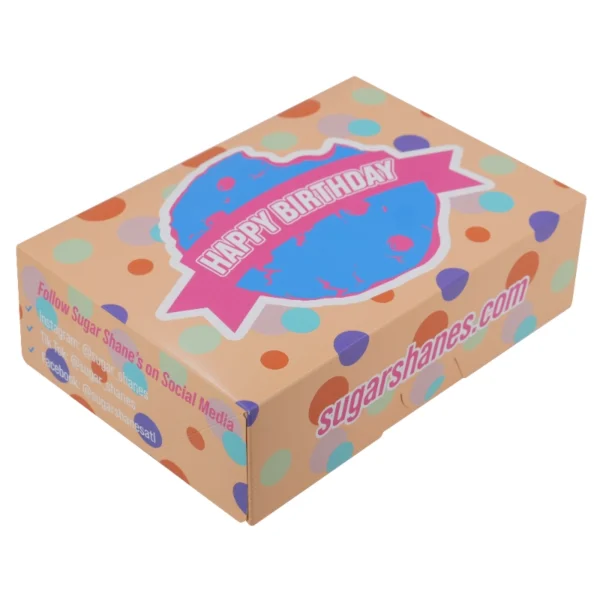
Choosing the Right Donut Box Structure
There is no universal structure that works for every donut product. The right donut packaging box depends on the size and type of donuts, the number packed per box, the level of protection required, the sales channel, storage conditions, assembly process, and branding requirements.
For brands developing custom donut paper boxes, it is worth discussing these factors before finalizing the design. A well-planned structure can reduce wasted space, simplify daily packaging work, protect the product during delivery, and give the finished package a more professional appearance.
Good donut packaging does not need to be complicated. It needs to be well matched to the product and practical enough to work every day. With the right structure and paper selection, a custom donut paper box can protect the product while giving the bakery a consistent and recognizable brand presentation.